3D Mapping & Fusion Biopsy
Targeted and systematic sampling can help clarify where clinically significant cancer is located and support treatment planning.
View patient guide →Prostate cancer diagnosis & focal therapy
Two focused areas of care: precise diagnosis and individualized treatment for prostate cancer, and modern treatment options for benign prostatic hyperplasia (BPH).
For appointments and clinical questions. Not for emergencies.
Professor of Surgery / Urology
A measured approach
Prostate cancer is not one uniform condition. Its location, grade, extent, and the patient’s priorities all matter. The goal is to define the disease accurately, discuss the full range of reasonable options, and avoid treatment that is more extensive than necessary.
Focal therapy may be appropriate for selected patients, but it is not suitable for every prostate cancer. Evaluation and follow-up are essential.
Prostate cancer
Care begins by defining the location, grade and extent of disease. Treatment may range from active surveillance to whole-gland treatment or focal therapy, depending on cancer risk, anatomy, health and patient priorities.
Targeted and systematic sampling can help clarify where clinically significant cancer is located and support treatment planning.
View patient guide →Image-guided freezing may treat a selected cancer focus or the entire prostate, depending on disease location and risk.
Irreversible electroporation uses electrical pulses rather than heat to ablate targeted tissue in carefully selected patients.
View patient guide →Thermal ablation of a targeted prostate lesion under image guidance. Long-term evidence and candidacy should be reviewed individually.
View patient guide →A consultation begins with your diagnosis, imaging, pathology, symptoms, and personal priorities.
Contact the clinic →Dr. Barqawi in the media
The videos below are published on Dr. Barqawi’s own YouTube channel. The articles link directly to the original news outlets.
YouTube · Dr. Barqawi
An archived clip about image-guided focal laser treatment and MRI thermal monitoring.
Read the focal laser guide →YouTube · Dr. Barqawi
A brief procedure clip demonstrating cryoprobe placement for prostate cryotherapy.
Read the cryotherapy guide →The diagnostic feature uses the “Battleship” analogy for prostate mapping and includes Dr. Barqawi’s perspective.
Read original article ↗ CBS News Colorado · 2014Low-T Patients Poised To Sue Drug MakersLocal reporting featuring Dr. Barqawi’s caution about indiscriminate testosterone prescribing.
Read CBS coverage ↗ Official YouTube archiveDr. Barqawi’s channelView the original source channel for the procedure clips used on this site.
Open YouTube ↗Enlarged prostate (BPH)
BPH can cause weak stream, urgency, frequency, nighttime urination, incomplete emptying or retention. Evaluation helps confirm obstruction and determine whether medication, a minimally invasive treatment or surgery is the best fit.
Minimally invasive option
Rezūm delivers short bursts of sterile water vapor into selected prostate tissue. As the treated tissue shrinks over time, the channel through the prostate can open and urinary symptoms may improve.
Summary based on Boston Scientific patient information. Individual recovery and results vary.
Laser treatment option
GreenLight uses a 532-nm laser delivered through a scope in the urethra to vaporize obstructing prostate tissue and create a more open urinary channel.
GreenLight Center of Excellence
Thousands of procedures performed at the University of ColoradoDr. Barqawi’s high-volume program has documented strong symptom improvement and a favorable safety profile. Boston Scientific’s Center of Excellence designation requires annual case-volume review, de-identified outcomes and at least 50% mean IPSS improvement in the submitted patient cohort.
Clinical volume is based on Dr. Barqawi’s University of Colorado operative experience. Center of Excellence is a Boston Scientific designation. Individual recovery and results vary.
Water-vapor ablation; tissue shrinks gradually
Laser vaporization; obstructing tissue is removed during the procedure
Usually office or outpatient
Usually operating room / outpatient surgery
Typically gradual over weeks to months
Urinary channel is opened during treatment; recovery symptoms may persist temporarily
Prostate size and anatomy, symptom severity, retention, anticoagulation, sexual priorities, anesthesia considerations and patient preference
Rezūm and GreenLight are trademarks of Boston Scientific. The linked and embedded videos are vendor-produced educational materials. Their inclusion is for patient education and does not replace an individualized discussion of benefits, risks and alternatives.
About Dr. Barqawi
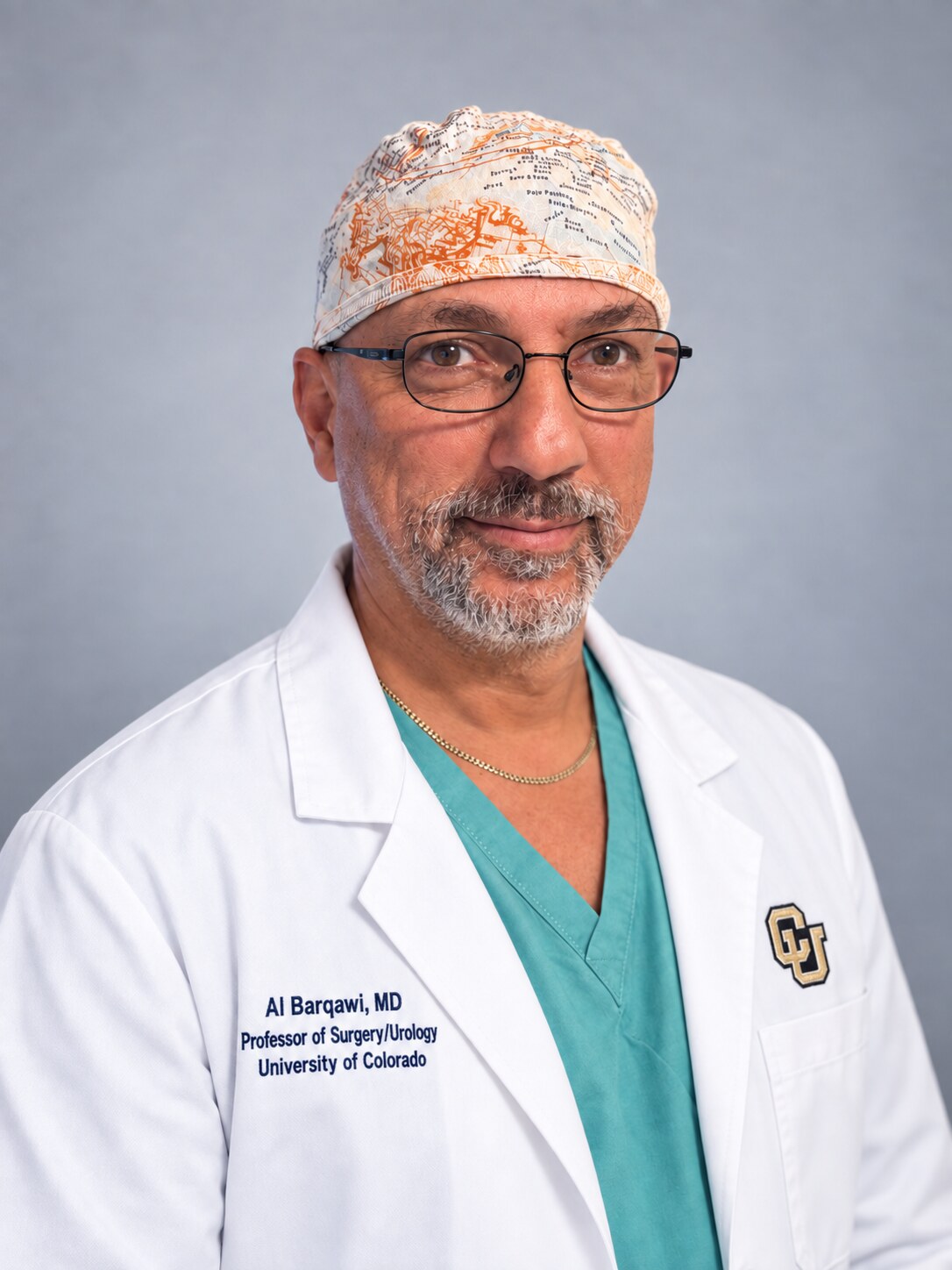
Professor of Surgery/Urology · Director, Prostate Cancer International Fellowship Program
30+ years of urologic experience. Dr. Barqawi joined the University of Colorado in 2002 and has held a faculty appointment since 2003.
His clinical and research work has focused on prostate cancer diagnosis, image-guided biopsy, and focal treatment strategies intended to balance cancer control with quality of life.
Academic work
Review Dr. Barqawi’s full professional record or open the major academic sections directly.
Training, appointments, honors, teaching, publications and presentations.
Open full CV ↗ Peer-reviewed workPublicationsJournal articles and research contributions listed in the academic CV.
Open at page 12 ↗ Scientific meetingsPresentations & AbstractsPublished abstracts, podium presentations and conference work.
Open at page 22 ↗ Academic teachingInvited LecturesInvited lectureships and teaching activities listed in the CV.
Open at page 5 ↗This website provides general educational information and does not replace medical advice, diagnosis, or treatment. Treatment suitability and outcomes vary. A clinician must review your individual history, pathology, imaging, and overall health.
Appointments & inquiries
University of Colorado School of Medicine
12631 East 17th Avenue, Room L15-5602
Aurora, Colorado 80045